All you want to know about us
Click here to share this article
Operating an inflatable device, such as a bouncy castle, slide, or obstacle course, carries inherent responsibilities. As industry professionals, we place the safety of users, particularly children, above all other considerations. Among the various environmental factors an operator must manage, wind speed is unequivocally the most critical and dangerous variable. A sudden gust of wind can transform a source of joy into a catastrophic hazard in mere seconds.
This comprehensive guide serves as an authoritative resource on bouncy castle wind speed limits, operational procedures, and the non-negotiable safety standards stipulated by law and industry best practices. We write this to inform and educate operators, event planners, and the public on the precise protocols required to prevent wind-related incidents.
Understanding the Critical Importance of Wind Speed for Inflatables
An inflatable structure is, by its very nature, a large, lightweight object. Its significant surface area acts as a "sail" against the wind. The forces exerted by wind are not linear; they increase exponentially with speed. A 20 mph wind, for example, exerts four times the force of a 10 mph wind.
This force, known as dynamic pressure or wind load, can cause several critical failure scenarios:
Overturning: The wind applies horizontal pressure to the side of the castle, causing it to tip and roll, potentially with occupants inside.
Uplift (Kiting): The wind creates a difference in pressure, similar to an aircraft wing (Bernoulli's principle), generating aerodynamic lift. This force can pull anchorage stakes directly from the ground or lift the entire unit, causing it to become airborne.
Anchorage Failure: The combined forces of lift and drag can exceed the holding capacity of the anchor points, leading to a sudden and complete detachment of the inflatable from the ground.
These are not theoretical risks. Tragic and severe incidents have occurred globally as a direct result of inflatables being operated in unsafe wind conditions. Therefore, adherence to established limits is not a guideline; it is an absolute operational imperative.
The Legal and Professional Standard: BS EN 14960 Explained
In the United Kingdom and across Europe, the benchmark for inflatable play equipment safety is BS EN 14960. This British and European Standard outlines the rigorous requirements for the design, manufacture, and, most importantly, the safe operation of inflatable play equipment.
We, and all reputable operators, anchor our safety procedures to this standard. BS EN 14960 is not optional advice; it forms the basis of a 'best practice' defence in law and is the standard referenced by the Health and Safety Executive (HSE) in the UK.
Defining the Maximum Wind Speed Limit
BS EN 14960:2019 (the most recent version) is explicit in its directive. It states that inflatable play equipment shall not be used in winds exceeding a specific limit.
The absolute maximum wind speed for operating a bouncy castle is 38 kilometres per hour (kph), which translates to approximately 24 miles per hour (mph).
This limit is not an arbitrary number. It is the scientifically determined point at which the forces of wind begin to challenge the stability and anchorage of a correctly installed, compliant inflatable.
Why 'Force 5' on the Beaufort Scale is the Absolute Cut-Off
The standard also references the Beaufort Wind Force Scale, a widely used empirical measure that relates wind speed to observed conditions on land or at sea.
The 24 mph limit corresponds directly to the very top end of Force 5, known as a "Fresh Breeze."
Force 4 (Moderate Breeze): 13-18 mph (20-29 kph). Wind raises dust and loose paper; small branches are moved. This is generally considered the upper limit for comfortable operation.
Force 5 (Fresh Breeze): 19-24 mph (30-38 kph). Small trees in leaf begin to sway; crested wavelets form on inland waters. This is the critical warning zone. Operation must cease at or before wind speeds consistently reach this level.
Force 6 (Strong Breeze): 25-31 mph (39-50 kph). Large branches in motion; whistling heard in telegraph wires; umbrellas used with difficulty. Operating an inflatable in these conditions is grossly negligent.
Any operator who relies on visual cues (like swaying trees) alone is acting improperly. The only professional method for determining wind speed is with a calibrated measuring device.
Essential Equipment: Using an Anemometer Correctly
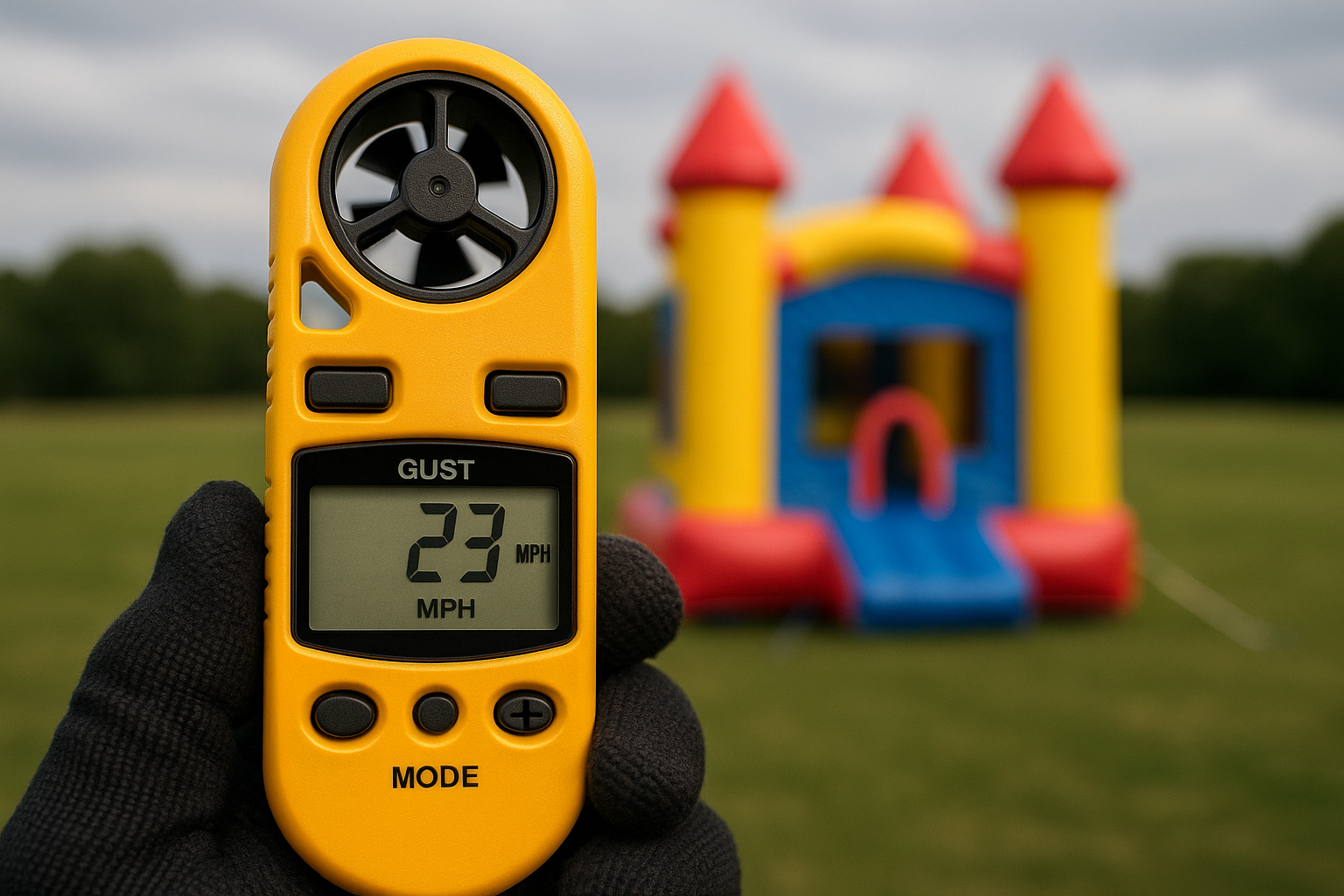
An anemometer is a device used for measuring wind speed. For a professional inflatable operator, this is not an optional accessory; it is a critical piece of safety equipment, as essential as the anchor stakes themselves.
Why Guesswork is Not an Option
Human perception of wind is notoriously unreliable. What "feels" like a light breeze in a sheltered garden may be a dangerous, high-speed gust in an open field. Furthermore, wind shielding from buildings, fences, or trees can create a false sense of security, while the wind speed just a few feet above or beyond the shelter is significantly higher.
Relying on weather forecasts is also insufficient. Forecasts provide a general overview for a wide area, but they cannot predict localised microclimates or the sudden, powerful gusts that are the true enemy of inflatable safety.
How to Take an Accurate Wind Speed Reading
We mandate that all our operators follow a strict protocol for measuring wind speed:
Use a Digital Handheld Anemometer: These devices provide clear, instant readings in your preferred unit (mph, kph, or m/s).
Measure at the Correct Height: Wind speed increases with altitude. The reading should be taken at a height of 1.5 meters (approx. 5 feet), representative of the main body of the inflatable.
Measure in an Open Area: Stand in the location where the inflatable will be sited, holding the anemometer at arm's length, facing into the wind. Do not take readings next to a building or wall, as this can create a "funnel effect" (accelerating wind) or a "wind shadow" (a false low reading).
Monitor Gusts, Not Averages: This is the most critical point. An anemometer will often show an "average" wind speed and a "maximum" (gust) speed. The 24 mph limit applies to the gusts. A steady 15 mph wind with gusts to 25 mph is unsafe. The operation must be based on the highest recorded gust.
Dynamic Risk Assessment: Wind is Not a Static Number
A professional operator does not simply take one reading at 9 AM and consider the job done. We conduct a dynamic risk assessment, which means the situation is constantly re-evaluated throughout the hire period.
Monitoring Changing Conditions
Wind is variable. An operator must take anemometer readings at regular intervals (e.g., every 30-60 minutes) and any time a change in conditions is visually or audibly apparent (e.g., wind "whistling," trees swaying more aggressively).
If at any point the wind gusts approach or exceed the 24 mph (38 kph) limit, the inflatable must be evacuated and deflated immediately.
The Influence of Local Terrain and Sheltering
The location of the inflatable drastically affects its exposure.
Open Fields: These are the most hazardous locations, offering no protection. The wind speed will be at its maximum.
Urban/Suburban Gardens: Houses, fences, and trees can provide sheltering. However, this can be deceptive. Gaps between houses can create wind tunnels that accelerate wind to dangerous speeds. Furthermore, a structure may block a steady breeze but be useless against a sudden, high-altitude gust that drops down onto the inflatable.
Hard Surfaces (Indoors): The only location where wind speed is not a factor is indoors, such as in a large sports hall. When operating on hard surfaces outdoors (e.g., concrete patios, car parks), the risk is compounded, as the inflatable relies on ballast (sandbags), which typically offer less holding power than deeply driven ground stakes.
Operational Procedures for Marginal and High-Wind Conditions
A clear plan of action is the hallmark of a professional service. We operate a "traffic light" system.
Green (0-18 mph): Conditions are safe. Proceed with setup, ensuring all anchorage points are secure as per manufacturer guidance. Continue to monitor.
Amber (19-23 mph): Conditions are marginal. This is the critical warning zone. Users should be removed from the inflatable. The unit should be kept inflated only for immediate re-use if the wind drops, but it must be under constant, direct supervision. Be prepared to deflate instantly.
Red (24+ mph): Conditions are dangerous. The unit must be immediately evacuated and deflated. It is not safe to re-inflate until readings have consistently dropped back into the "Green" zone for a sustained period.
The Deflation Protocol: A Non-Negotiable Safety Step
When the wind limit is breached, the following steps must be taken without delay:
Order all users to exit the inflatable immediately in a calm, orderly fashion.
Assist any users who need help to exit quickly.
Once the inflatable is confirmed empty, switch off the blower fan.
Open all air vents and zips to allow the unit to deflate rapidly.
Secure the deflated unit to prevent it from being moved by the wind while on the ground.
Beyond the Number: Additional Factors Compounding Wind Risk
While 24 mph is the absolute limit, other factors can lower this threshold.
Inflatable Type: Large inflatables, particularly slides and high-walled obstacle courses, have a much larger "sail area" and a higher centre of gravity. We may enforce a lower wind speed limit for these specific units.
Ground Conditions: The holding power of anchorage is critical.
Dry, Hard Ground: Provides the best grip for stakes.
Wet, Saturated Ground: Provides significantly less grip. Stakes can pull out at much lower forces. In these conditions, we insist on using longer stakes (e.g., 500mm instead of 380mm) and may reduce the maximum wind speed limit accordingly.
Hard Standing: Ballast (sandbags) must be used. Each anchor point requires a minimum of 163 kg of weight. This is often impractical, and we strongly advise against setting up on hard standing in any wind.
Rain: Rain makes the inflatable's surface extremely slippery, increasing the risk of user injury. While not directly related to wind, the combination of wind and rain creates an unsafe and unpleasant environment, and we would advise ceasing operation.
Our Commitment to Inflatable Safety
As a responsible provider, our position is firm and unambiguous. We will never compromise on safety. Our operators are trained to assess wind conditions professionally and are fully empowered to cease operations if they deem the situation to be unsafe.
We understand that this can be disappointing for a planned event, but a child's life is not worth the risk. The 24 mph (38 kph / Force 5) limit is absolute. We will not deploy, or will immediately deflate, any bouncy castle or inflatable that is exposed to winds at or exceeding this speed. We urge all members of the public to hold any inflatable operator to this same, non-negotiable standard.